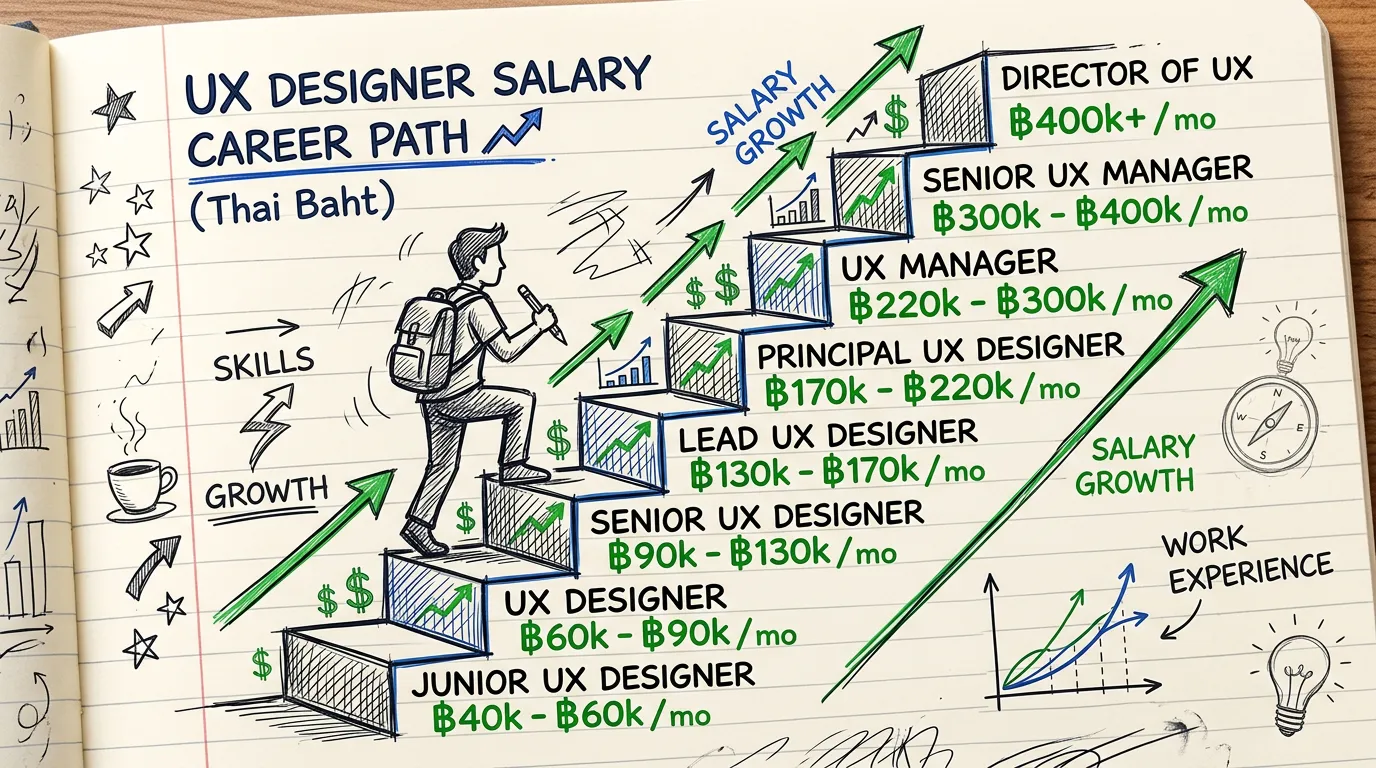
UX UI Designer Salary in Thailand 2026: A Complete Career Guide by Experience Level
A comprehensive breakdown of UX UI designer salaries in Thailand across all career levels, from Junior to Head of Design. Covers factors that affect compensation, highest-paying industries, skills that command premium pay, and practical negotiation strategies -- written from 15+ years of industry experience.
The Salary Question Nobody Answers Directly
In the UX design community in Thailand, compensation remains one of the most frequently asked yet poorly answered questions. Job postings rarely list salary ranges. Peers hesitate to share numbers. HR departments deflect with "it depends on experience."
Having spent over 15 years in UX career paths -- from the era when "web designer" was the closest title we had, through to managing UX teams at the enterprise level -- I have seen compensation data across hundreds of roles. My own career, my team members, candidates I have interviewed, and professionals who have sought career advice have all contributed to a reasonably clear picture of what a UX designer or UI UX designer earns in Thailand.
This article provides concrete salary ranges, the factors that actually move the needle, and practical strategies for maximizing your earning potential.
UX UI Designer Salary Ranges by Level in Thailand
The figures below reflect market rates observed in medium to large organizations based in Bangkok, covering in-house product teams, agencies, and consultancies. Salaries outside Bangkok tend to be 15-25% lower.
Junior UX/UI Designer (0-2 years)
Salary range: 18,000 - 35,000 THB/month
At this level, the salary spread is driven almost entirely by portfolio quality and the ability to articulate design decisions. A candidate with a strong portfolio and bootcamp training can start at 25,000-30,000 THB, while those with weaker portfolios may begin at 18,000-22,000 THB. Academic credentials have minimal impact compared to demonstrated capability.
Mid-level UX/UI Designer (2-5 years)
Salary range: 35,000 - 60,000 THB/month
This is the stage where many designers feel stuck. Annual raises of 5-8% at the same company yield slow growth. Those who break past the 50,000 THB threshold typically possess strong research skills or work within product teams where they own specific metrics. Execution-only designers -- those who work strictly from briefs without contributing to product strategy -- tend to plateau here.
Senior UX/UI Designer (5-8 years)
Salary range: 60,000 - 100,000 THB/month
The Senior level reveals a clear divergence between "senior by tenure" and "senior by capability." Designers earning 80,000 THB and above at this level can typically lead projects end-to-end, manage stakeholder relationships, and translate business requirements into design strategy. Technical craft alone is insufficient; strategic thinking becomes the differentiator.
Lead / Principal Designer (8-12 years)
Salary range: 90,000 - 150,000 THB/month
The Lead or Principal title is not yet widespread in Thailand. Many organizations jump directly from Senior to Manager. However, companies with higher design maturity maintain this track for exceptional individual contributors who prefer depth of craft over people management. At this level, the expectation is that you set design direction for the entire team or product area.
UX Manager / Head of Design (10+ years)
Salary range: 100,000 - 200,000+ THB/month
Manager-level compensation varies significantly based on team size, company scale, and industry. A UX Manager at a mid-size Thai company may earn 100,000-130,000 THB, while a Head of Design at a multinational can exceed 200,000 THB. The determining factor is scope of impact -- the breadth of products, users, and business outcomes under your responsibility.
Key Factors That Determine Compensation
Company Size and Type
This is the single largest variable in UX designer compensation, yet it is frequently overlooked. Two designers with identical skills and experience can see a 30-50% salary difference based solely on employer type.
- Thai startups: Typically pay 10-20% below market, sometimes offset by equity or stock options
- Large Thai corporates: Pay according to structured salary bands with predictable 5-8% annual increases
- Multinational corporations (MNCs): Generally pay 20-40% above local market rates, with stronger benefits packages
- Agencies and consultancies: Mid-range salaries, but rapid exposure to diverse projects and industries
- Fintech and tech companies: Often the highest-paying segment due to intense competition for talent
Highest-Paying Industries for UX in Thailand
Based on observed compensation data across the market, the industries that pay the most for UX talent in Thailand, ranked from highest to lowest:
- Banking and Financial Services -- Major banks undergoing digital transformation invest heavily in UX talent who can handle complex product ecosystems
- E-commerce and Marketplace Platforms -- Where conversion rate improvements translate directly to revenue, making the ROI of UX quantifiably clear
- Fintech and Digital Payments -- A fast-growing sector with aggressive talent acquisition, driving salaries upward
- Insurance and Insurtech -- Increasingly prioritizing digital customer experience, particularly companies pursuing direct-to-consumer models
- Technology Companies and SaaS -- Often international companies with Thailand offices that benchmark against global compensation standards
Skills That Command the Highest Salary Premium
Not all skills contribute equally to compensation. The following capabilities consistently correlate with above-market pay:
- UX Research: Designers who conduct genuine research -- beyond basic usability testing -- are scarce in the Thai market, creating high demand
- Data-informed design: The ability to interpret analytics and use data to inform design decisions significantly strengthens negotiating leverage
- Design systems: Building and maintaining scalable design systems is highly valued in enterprise organizations
- Advanced prototyping: Beyond static Figma mockups -- creating interactive, testable prototypes that reduce development risk
- Business acumen: Speaking the language of business stakeholders is the skill that most clearly separates Senior from Mid-level compensation
- English communication: In multinational contexts, strong English proficiency can add 20-30% to compensation compared to equivalent Thai-only roles
For resources on developing these high-value skills, see the Knowledge section.
Career Path: Individual Contributor vs. Manager
A common assumption is that management is the only path to higher compensation. The 2026 reality in Thailand challenges this. Companies with mature design organizations now offer IC (Individual Contributor) tracks that can match management compensation.
IC Track (Individual Contributor)
- Progression: Junior, Mid, Senior, Staff/Principal
- Strengths: Deep craft focus, no people management overhead, emphasis on quality and innovation
- Consideration: Requires continuous skill investment; falling behind on industry evolution leads to rapid obsolescence
- Salary ceiling: 100,000 - 150,000 THB (at companies with established IC tracks)
Management Track
- Progression: Senior, Lead, Manager, Head of Design, VP/Director
- Strengths: Broader organizational influence, ability to shape design culture at scale
- Consideration: Progressively less hands-on design work; organizational politics become a significant part of the role
- Salary ceiling: 150,000 - 200,000+ THB
The critical point: choosing the management track solely for higher pay is a recipe for dissatisfaction. If you do not genuinely enjoy mentoring, navigating organizational dynamics, and spending most of your time in meetings rather than in design tools, the trade-off will not be worth it. Read more on career reflections and insights on the blog before making this decision.
How to Negotiate UX Designer Salary Effectively
Salary negotiation is an area where many designers in Thailand leave significant money on the table. Cultural norms around modesty and conflict avoidance often work against candidates. Here is a structured approach.
Before the Interview
- Research market rates thoroughly: Use resources like this article, community discussions, JobsDB, LinkedIn Salary Insights, and Glassdoor to establish a baseline
- Quantify your value: Prepare specific examples of business impact -- metrics you improved, problems you solved, revenue you influenced
- Define a range, not a single number: Set your floor at a number you would genuinely be satisfied with, and your ceiling at the top of the realistic market range for your level
During the Interview
- Avoid disclosing current salary if possible: When asked, redirect with "I would prefer to focus on what is appropriate for the scope and responsibilities of this role"
- Ask about the budget: "What is the compensation range budgeted for this position?" is a reasonable question that shifts the anchor point
- Discuss total compensation: Base salary is one component. Inquire about bonuses, benefits, remote work policies, professional development budgets, and review cycles
After Receiving an Offer
- Do not respond immediately: Requesting 2-3 days to consider is standard and expected
- Counter with reasoning: If the offer falls below your range, provide evidence-based justification, not simply "I want more"
- Negotiate beyond base salary: If the salary number cannot move, explore signing bonuses, accelerated review timelines, additional PTO, or training budgets
Realities That Are Rarely Discussed
Salary growth is not automatic
In the Thai work environment, many professionals wait passively for annual raises, which typically amount to 5-8%. However, the fastest salary growth comes from strategic job changes every 2-3 years, where each move can yield a 20-40% increase. This is not an endorsement of frequent job-hopping, but if you have remained at the same company for five years with minimal salary movement, the external market may value you significantly more than your current employer does.
Title does not guarantee compensation
I have observed "Senior UX Designers" earning 45,000 THB and untitled "UX Designers" earning 75,000 THB. The difference is company and scope, not title. Do not conflate title prestige with financial value.
Freelancing is not automatically more lucrative
Many designers assume that freelancing yields higher income. While hourly rates may be higher, factoring in client acquisition time, gaps between projects, self-funded benefits, and tax obligations, the net difference is often smaller than expected. Successful freelancing requires a strong professional network and adequate financial reserves.
Final Advice: Invest in Skills, Not Titles
After 15 years in this field, the clearest pattern I have observed is this: professionals who earn well over the long term are not those who chased the biggest titles. They are the ones who invested consistently in building real, demonstrable skills.
Titles are assigned by companies and can be taken away just as easily. A restructuring can change your "Senior" to "Designer" overnight. But the skills you have built -- the ability to conduct rigorous research, to translate data into design insight, to align stakeholders around a shared vision, to build systems that scale -- those remain with you regardless of title or employer.
The designers who never worry about salary are those whose skills make them indispensable. The market will always find them.
If you are at a point in your UX career where you need clarity on which skills to develop next, or you want perspective from someone who has seen the full arc of this profession, consider booking a career consultation. I am happy to help you see the bigger picture.
Do not chase titles. Chase skills. The salary will follow.
Free UX Consultation
Fill in a few details and I'll reach out via LINE or Email