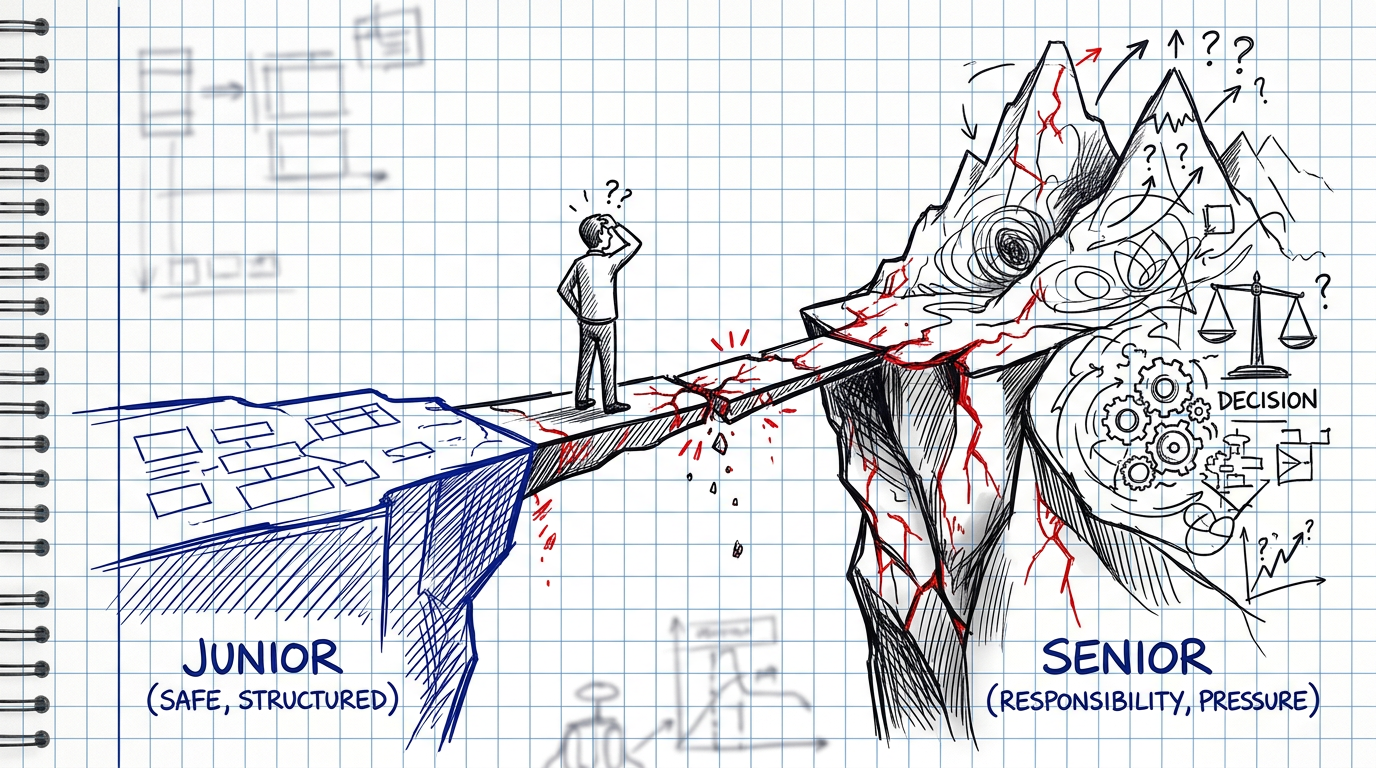
The Gap Nobody Talks About: The Space Between Junior and Senior in a UX Team
The path from Junior to Senior UX isn't just about putting in more years — it's about shifting from someone who takes orders to someone who drives direction, under the pressure of organizations that still struggle to measure UX through KPIs. This article is written from 15 years of experience in UX.
The Gap Nobody Teaches You About
Every career path has a gap in the middle. But in a UX team, it hurts more than anywhere else.
Junior UX has a clear path — follow the brief, deliver wireframes, wait for feedback, revise based on comments. Everything has a scope that someone else defines for you. You know exactly what you need to do today.
Senior UX also has a clear path — set direction, make decisions, mentor the team, talk to stakeholders. Everything has ownership that you're responsible for.
But the middle? The middle is no man's land.
You're no longer a Junior, but you haven't earned Senior-level trust yet. You start seeing problems bigger than wireframes, but you don't have the authority to fix them. You know what's wrong, but nobody asks for your opinion.
This is the gap that makes so many people leave UX altogether.
The Workload That Grows Disproportionately
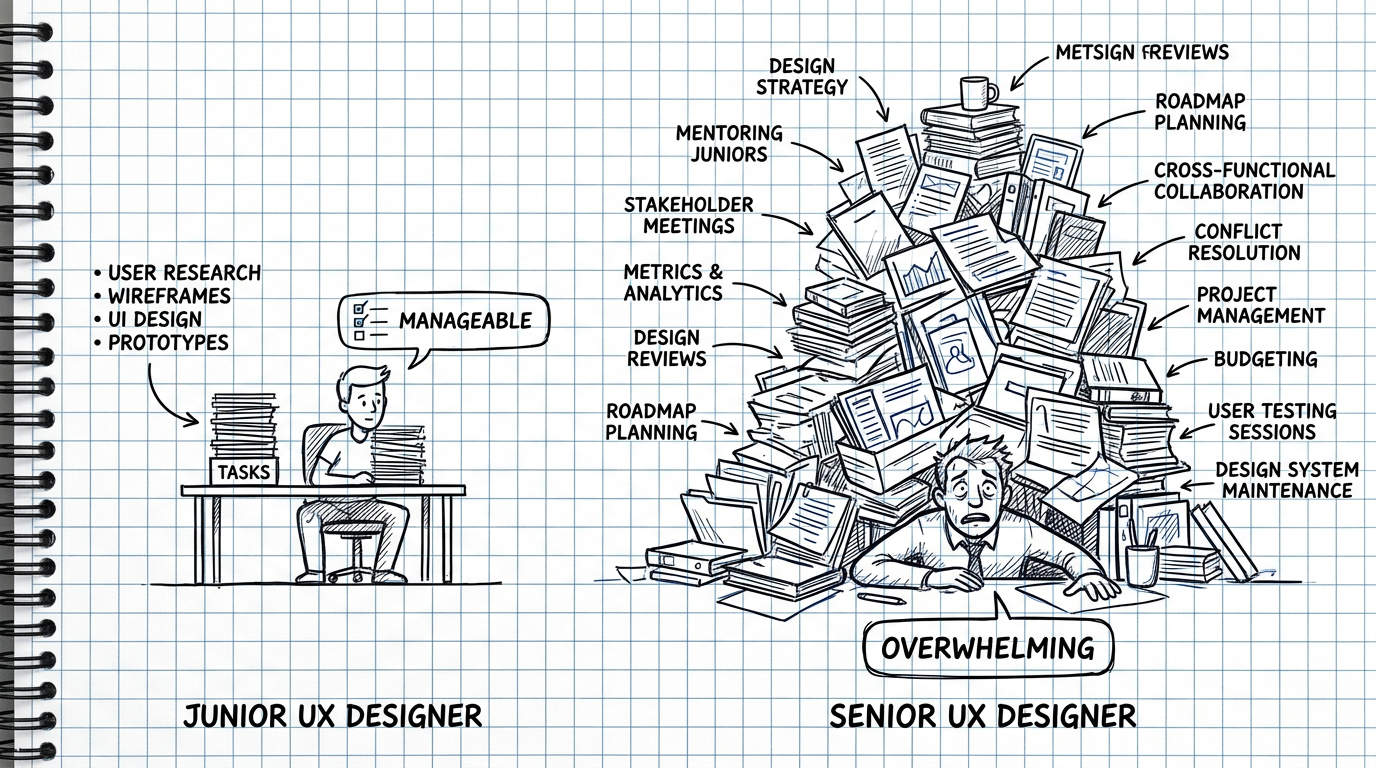
As you move up, what happens isn't just "doing the same design work but harder" — it's taking on entirely new roles while none of the old ones go away.
What Juniors Do
- Create wireframes / prototypes based on requirements
- Build user flows based on specs they receive
- Submit work for Senior review
- Revise work based on feedback
What Seniors Must Do (On Top of Everything Above)
- Consolidate User Experience — maintain consistency across features, across products
- Hands-on delivery — still do design work yourself because the team is small
- Mentor and review Junior work
- Talk to PM, Dev, Business to negotiate scope
- Present and defend design decisions to senior stakeholders
- Measure and prove how UX impacts the business
It's like being asked to be both the player and the coach at the same time — but only getting paid as a player.
Pressure From Every Direction
Pressure from above: "How do we measure UX?"
This is the question every Senior UX dreads.
In organizations where Engineering is measured by velocity, QA by bug count, and PM by feature delivery — UX becomes the intangible thing.
"The design looks nice, but how does it affect revenue?"
"We invested 2 months in research. What did we get out of it?"
"Why do we need a design system? Dev can build UI on their own."
Every one of these questions demands numbers — but the value of UX often lives in things that are hard to measure: reduced confusion, increased confidence, tasks completed faster than before.
Pressure from below: "Can you teach me too?"
Juniors on the team expect you to be their mentor. But the time you have for mentoring gets eaten up by meetings, stakeholder management, and delivery work you have to do yourself.
You want to teach. You want to give them time. But the reality is deadlines never move for you.
Pressure from the sides: "Why isn't the design done yet?"
PM asks. Dev asks. QA asks. Everyone is waiting on design like it's the bottleneck of the entire pipeline.
And many times it is — because a single Senior UX has to review the whole team's work, consolidate the experience across features, and still do hands-on design themselves.
The Fork in the Road: 3 Paths for Senior UX
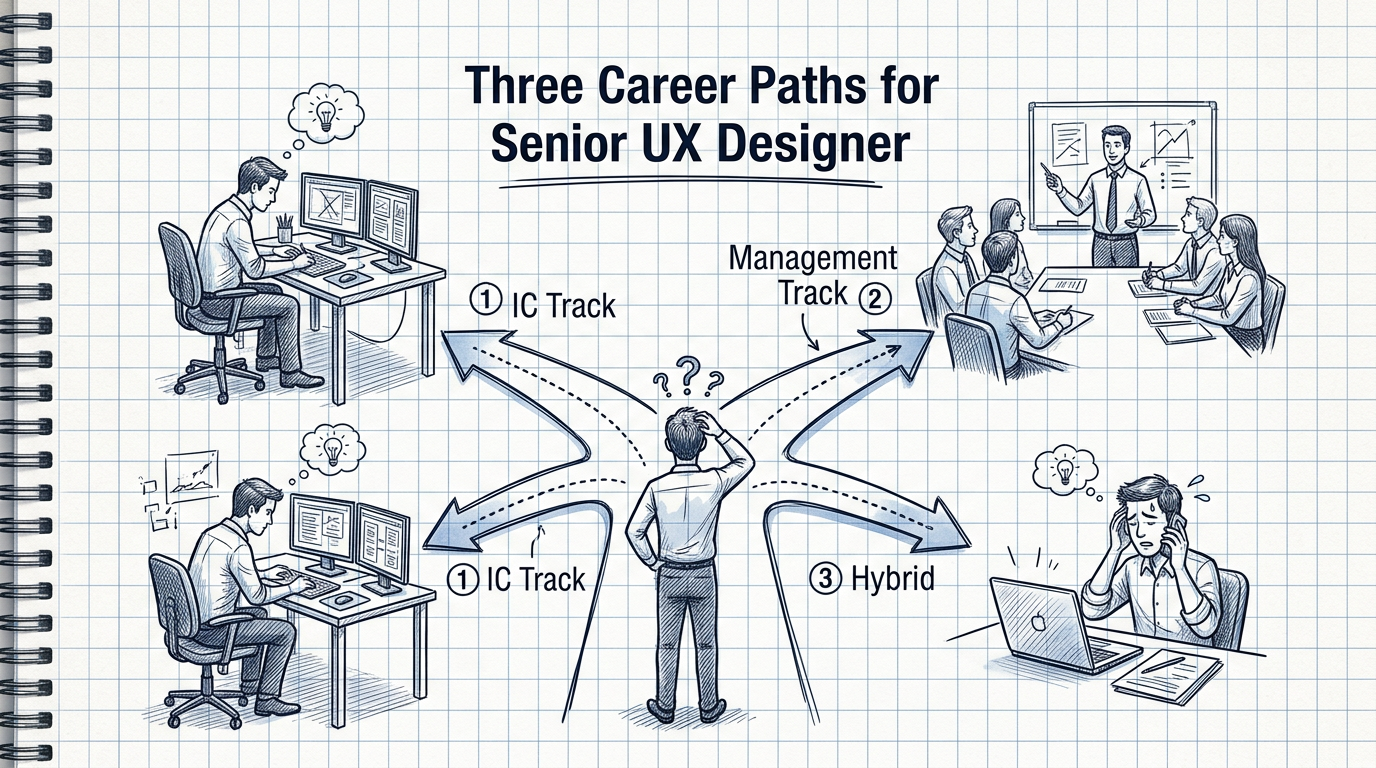
At some point, Senior UX has to choose — not "what to do" but "what to become."
Path 1: IC Track (Individual Contributor)
Go deep into the craft. Become the specialist everyone comes to for advice.
- Pros: You get to do the craft you love, impact through quality of work
- Cons: In many organizations, the IC track doesn't have a clear career path, and salary hits a ceiling fast
- Best for: People who still love hands-on design and don't want to manage people
Path 2: Management Track
Stop doing design yourself. Shift to managing the team, setting direction, talking to C-level.
- Pros: You have authority to make decisions, clearer career path
- Cons: You drift from the craft, may feel like "I'm not really doing UX anymore"
- Best for: People interested in strategy, organization, and people management
Path 3: Hybrid (The Reality of Small UX Teams)
Do both IC and management — which is the reality for most UX teams.
- Pros: You understand both craft and business, high flexibility
- Cons: Extremely high burnout risk, you do everything but don't excel at any one thing
- Best for: People in organizations where the UX team is still small (1-3 people)
Survival Strategies: Making UX Tangible
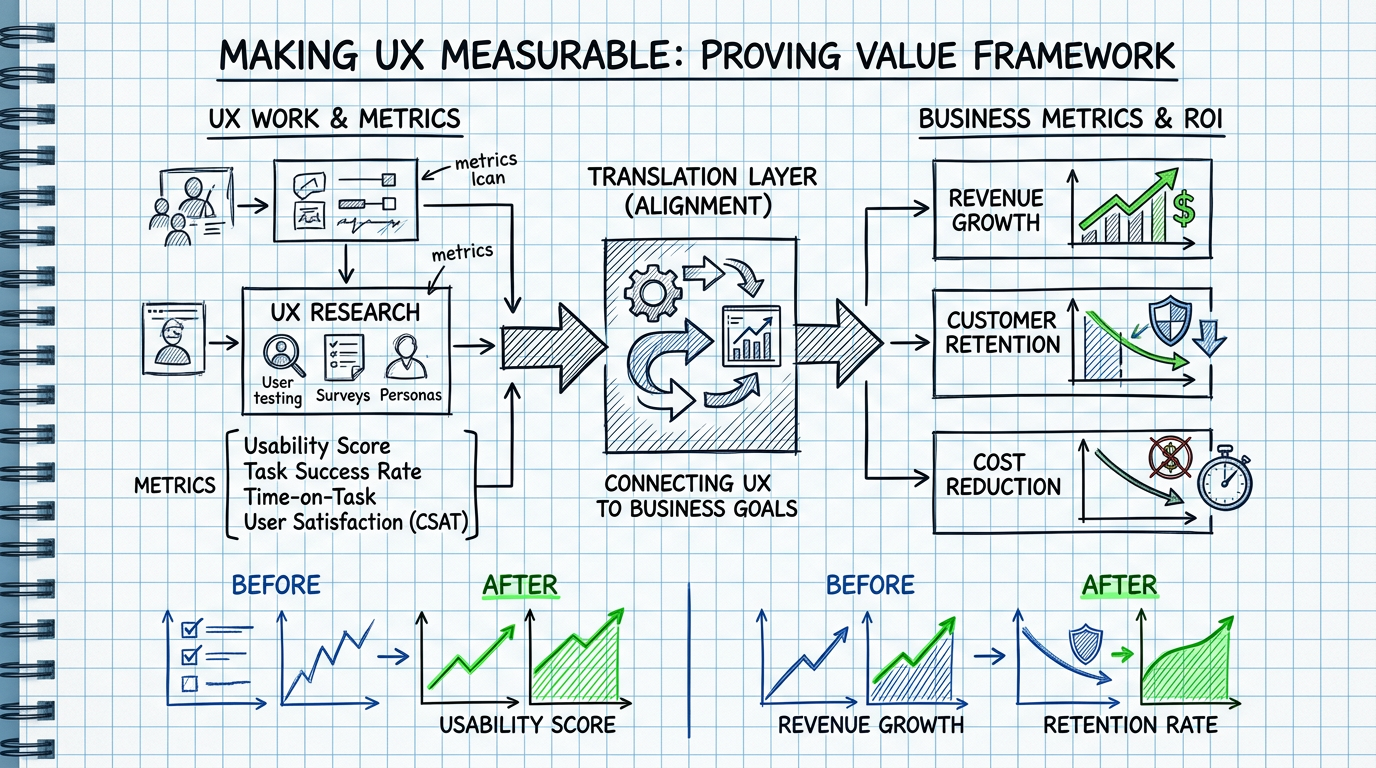
If the organization can't measure UX, don't wait for them to figure it out — measure it yourself and bring them the results.
1. Tie UX Metrics to Business Metrics
Don't say "we improved the UI" → Say "we reduced drop-off at step 3 by 23%, which increased conversion by X dollars."
- Task completion rate increased → More customers complete purchases = more revenue
- Time on task decreased → Fewer support calls = lower operational costs
- Error rate decreased → Less rework cost = dev doesn't have to fix the same bugs
- NPS/CSAT increased → Better retention = higher lifetime value
2. Document Everything You Do
The problem with UX is when it's done well, nobody notices — users will never say "wow, this form is so easy to use," but they'll complain the moment it isn't.
Build a design log:
- Before/After screenshots of every improvement
- Metrics before and after redesign
- User feedback quotes
- Dev time saved from having a design system
3. Build Alliances with PM and Dev Lead
UX can't survive alone. You need:
- A PM who understands that research isn't a waste of time
- A Dev Lead who agrees that a design system helps reduce tech debt
- A Data Analyst who can help pull impact numbers for design changes
4. Stop Proving Yourself Through Deliverables
Juniors prove themselves by the number of wireframes they ship. Seniors must prove themselves through decisions that are right.
"We chose not to build this feature because research showed users don't need it" — that's the value a Senior UX provides, even when there's no tangible deliverable to show for it.
If You're Stuck in the Middle Right Now
For those standing at this gap right now — I get it. I've been there.
It feels like you're being stretched in every direction. You have to do design. You have to manage the team. You have to prove value. But nobody tells you how.
Here's what I want to tell you:
1. Don't carry everything alone. If you're the only Senior UX on the team, it's not your fault that you can't handle it all. That's a structural problem with the organization.
2. Pick your battles. You can't fix every UX problem at once. Choose 1-2 things with the highest impact, deliver visible results, then expand from there.
3. Build a track record. Every time a design change produces positive results, write it down. Keep accumulating. When it's time to negotiate salary or headcount, you'll have the evidence.
4. Accept that some organizations aren't for you. If an organization truly doesn't value UX, no matter how hard you try to prove it, sometimes the answer isn't "how do I make them understand" — it's "go somewhere they already do."
5. Invest in your network. The UX community may be small but it's tight-knit. There are plenty of people who've been through the same struggles. Don't fight alone.
Final Thoughts
The gap between Junior and Senior isn't about skill or seniority — it's about a complete shift in how you think. From someone who waits for answers to someone who creates them.
And the hardest part isn't making good design — it's making people who don't understand design see its value.
If you can do that, you won't just be a Senior UX.
You'll be the person who permanently changes how your organization sees User Experience.