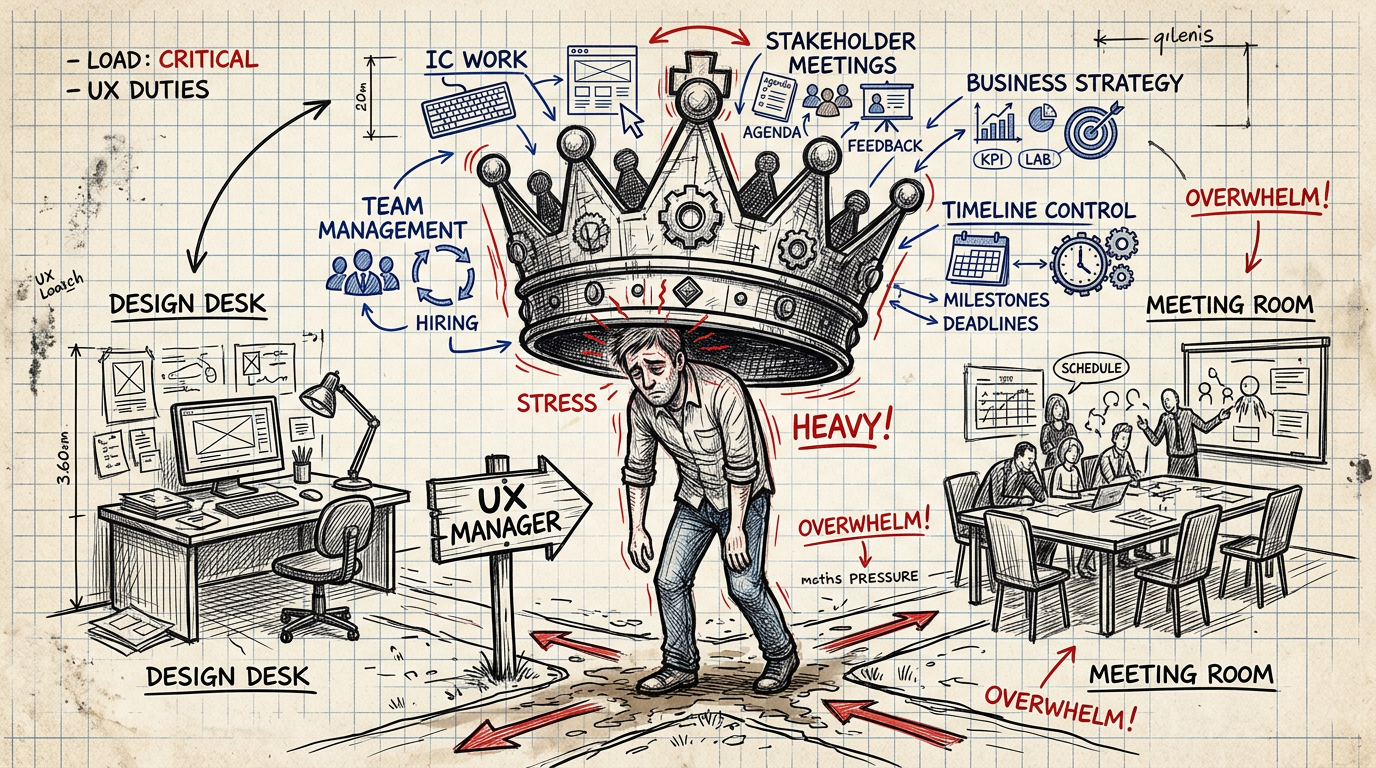
Becoming a UX Manager: A Path Not Paved with Rose Petals
The UX Manager title isn't a reward — it's an entirely new set of burdens stacked on top of the ones you already carry. From being a great designer to negotiating, leading, reviewing, and still doing IC work simultaneously — here's the reality nobody talks about.
The Crown Is Heavier Than You Think
The day you get promoted to UX Manager, everyone congratulates you. "Well deserved!" "Finally!" "You earned it!"
But nobody tells you that starting tomorrow:
- You still need to do design work yourself because the team is small
- You have to review every piece of work your team produces
- You must attend stakeholder meetings with people who don't understand UX, every week
- You have to protect your team from unreasonable demands
- You need to prove the value of UX to people who keep asking "how do you even measure UX?"
The UX Manager title isn't a reward — it's an entirely new set of burdens stacked on top of the ones you already carry.
Reality Check #1: You're Still an IC
In most organizations, UX teams have 2–5 people. Being a UX Manager doesn't mean you sit back and manage — you still have to get your hands dirty with design work, just like before.
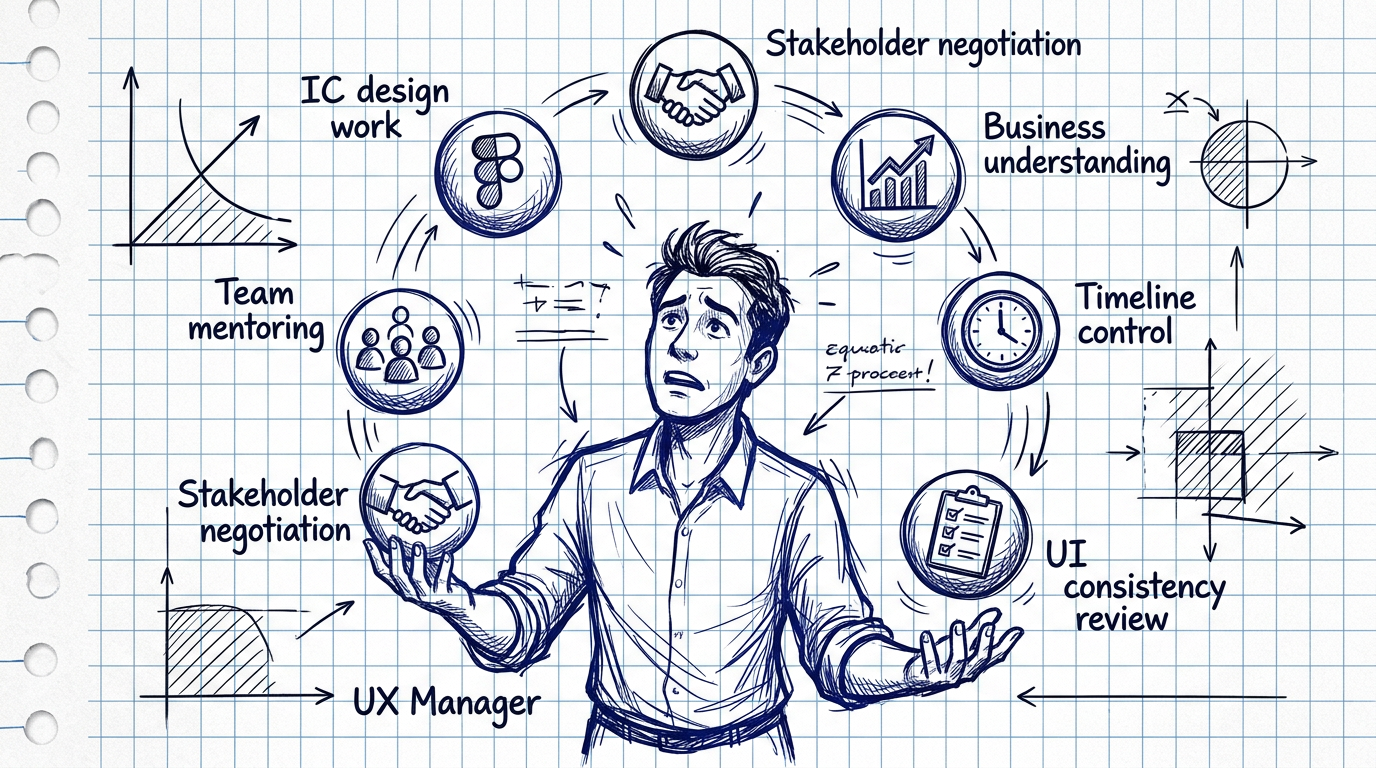
Here's what a typical day looks like:
Morning — Review 3 sets of wireframes from Juniors. Give feedback that's constructive but on point.
Mid-morning — Meet with PM about Q2 scope. Negotiate which features are essential and which can be cut.
Afternoon — Do your own design work for a feature that's too complex to assign to anyone else.
Late afternoon — Present UX strategy to the VP. Translate design language into business language.
Evening — Address the design questions dev sent over, review a PR where the UI doesn't match spec.
Night — Prioritize the backlog for next sprint.
This is every day. Not an unusually heavy one.
The Skills Nobody Teaches You
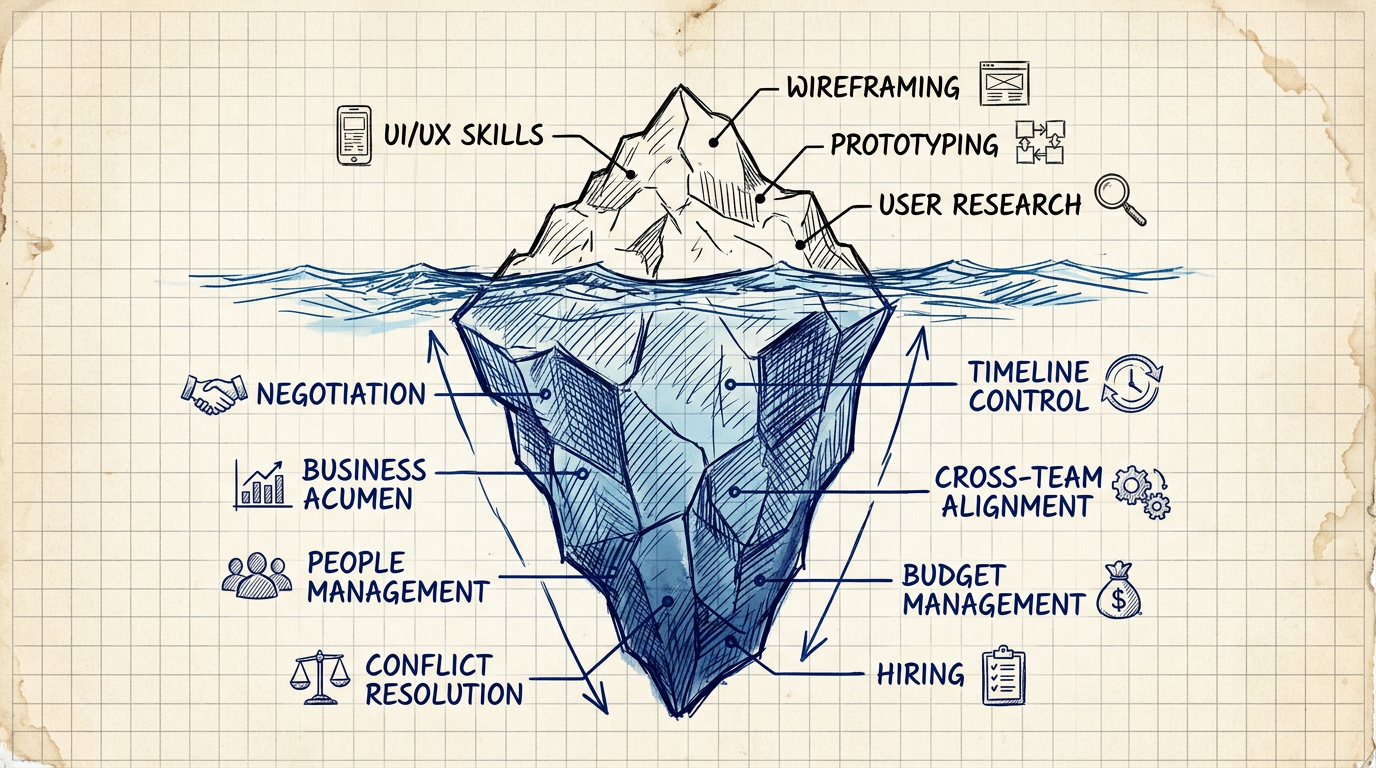
As a Designer, you need to be good at UX/UI — wireframes, prototypes, research, usability testing. That's the part above the waterline.
But as a Manager, the much larger part is underwater:
1. Negotiation
Every day you'll need to negotiate:
- With PM: "This feature needs research first. I know the deadline is close, but shipping without data will cost us more time in the long run."
- With Dev Lead: "I understand implementing this animation is complex, but let me explain why this transition matters for the user experience."
- With VP: "I respectfully disagree with this feedback. Let me explain why the current design better addresses user needs."
- With your Junior: "This work is good, but try to imagine how a first-time user who's never used the app would feel."
Negotiation isn't just arguing — it's the art of helping people who think differently see the same picture, without making anyone feel like they lost.
2. Business Acumen
A UX Manager who only speaks "user experience" without understanding business will be sidelined quickly.
You need to know:
- How the company's revenue model works
- What the OKRs are for this quarter
- What competitors are doing
- What the conversion, retention, and churn numbers look like
Because the only language executives listen to is the language of numbers — if you say "UX improved," nobody cares. But if you say "this redesign increased conversion by 15%," everyone listens.
3. Timeline Management
UX Designers manage their own timelines. UX Managers manage everyone's timelines.
- Junior A's research must finish before Junior B can start designing
- Feature X needs to be handed off to dev by Friday, but the design hasn't passed review
- A stakeholder reschedules the design approval meeting, so the entire sprint needs to adjust
You need to see the full picture of dependencies and adjust plans in real-time as things change — which happens daily.
4. UI Consistency Across the Team
This is invisible but critical work — when multiple UX people design simultaneously, each brings slightly different habits:
- Junior A uses 16px spacing, Junior B uses 20px
- Components in Feature X and Feature Y look similar but aren't identical
- Microcopy tone of voice is inconsistent
- Icon styles mix outlined and filled
The UX Manager has to guard all of this consistency — reviewing every screen, every flow, every component to make the product feel like "one thing."
5. People Management
No UX skill prepares you for this:
- A Junior whose work isn't good enough — how do you give feedback that's constructive without destroying confidence?
- Team members who don't get along — how do you resolve conflict?
- A team that's burning out — how do you protect them without making the business unhappy?
- Hiring new people — how do you evaluate portfolios? What interview questions do you ask?
Pulled in Two Directions
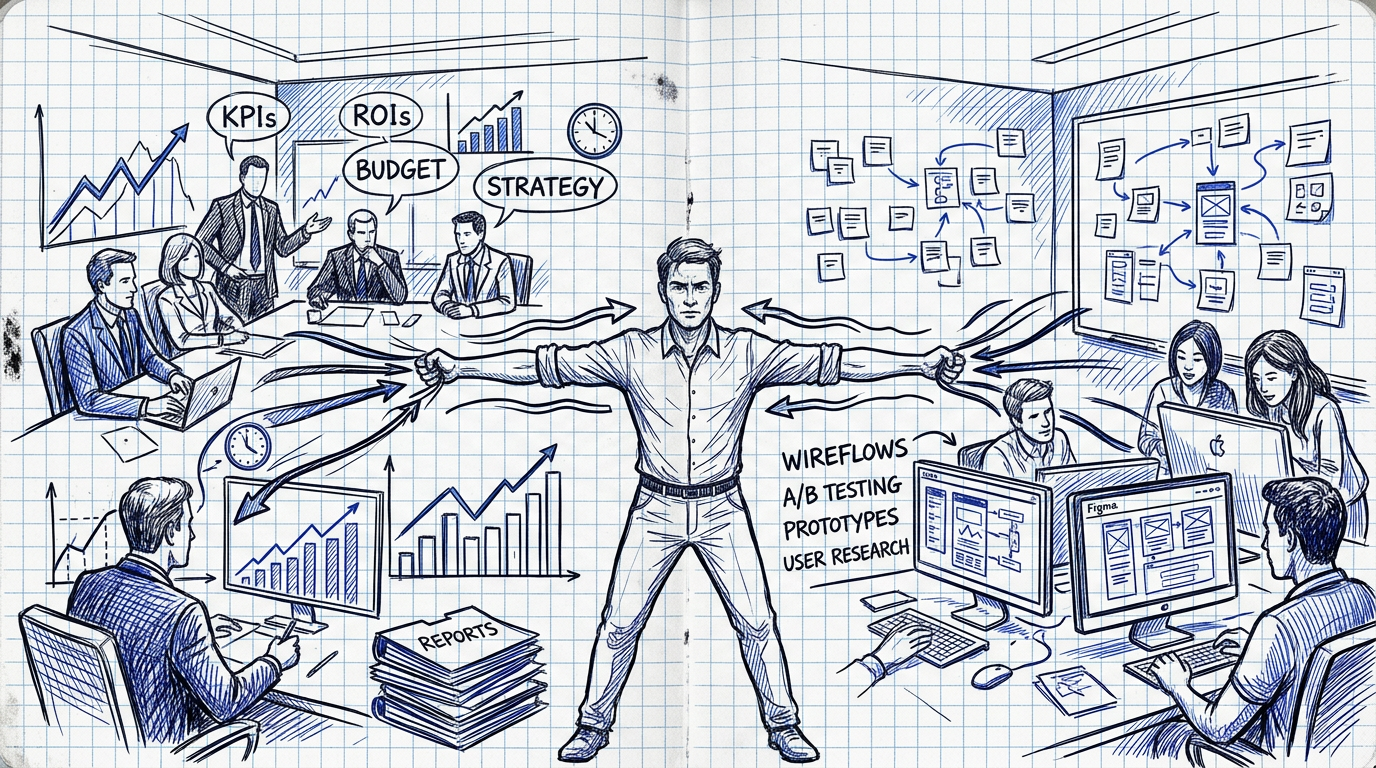
The hardest part of being a UX Manager is existing between two worlds.
The Business World
Executives want:
- Features delivered on schedule
- Lower costs, higher revenue
- Everything measured in numbers
- Move fast, ship fast
The Craft World
The UX team wants:
- Adequate time for research
- Creative freedom
- Quality that isn't compromised by deadlines
- Recognition for invisible work
The UX Manager must translate between these two worlds constantly.
When the VP asks "why isn't the design done yet?" you explain that research takes time without making the VP think the team is slow.
When your Junior asks "why did we cut this feature?" you explain that a business decision doesn't mean UX doesn't matter.
You're a translator between business and craft — and often, neither side will be happy with you.
Lessons I Learned the Hard Way
"Being a good manager ≠ being the best designer on the team"
When I first became a manager, I tried to also be the "best designer on the team" — reviewing every piece of work and fixing it myself, giving extremely detailed feedback. The team ended up feeling zero ownership.
I learned that a manager's job isn't to produce the best design, but to enable the team to produce the best design on their own.
"You don't need to be in every meeting"
Early on I attended every meeting — every design review, every sprint planning, every stakeholder sync. I'd end up with 6–7 hours of meetings per day and 1–2 hours of actual work.
I learned that you must choose which meetings need you personally and what can be delegated — which is also a way of developing your team.
"Conflict isn't a bad thing"
I used to fear conflict — afraid that arguing with PM would ruin the relationship, afraid that giving Junior too-direct feedback would make them quit.
I learned that healthy conflict is a sign that people care — the problem isn't conflict itself, but conflict that goes unresolved.
"You don't need to prove yourself every day"
UX Managers don't have tangible deliverables every day — no wireframes shipped daily, no code committed daily.
I used to feel guilty thinking "I didn't produce anything today" when I'd actually spent the entire day unblocking the team, making 20 decisions, and protecting scope from scope creep.
I learned that a manager's value isn't in what they make with their hands, but in the outcomes the entire team delivers.
A Survival Guide
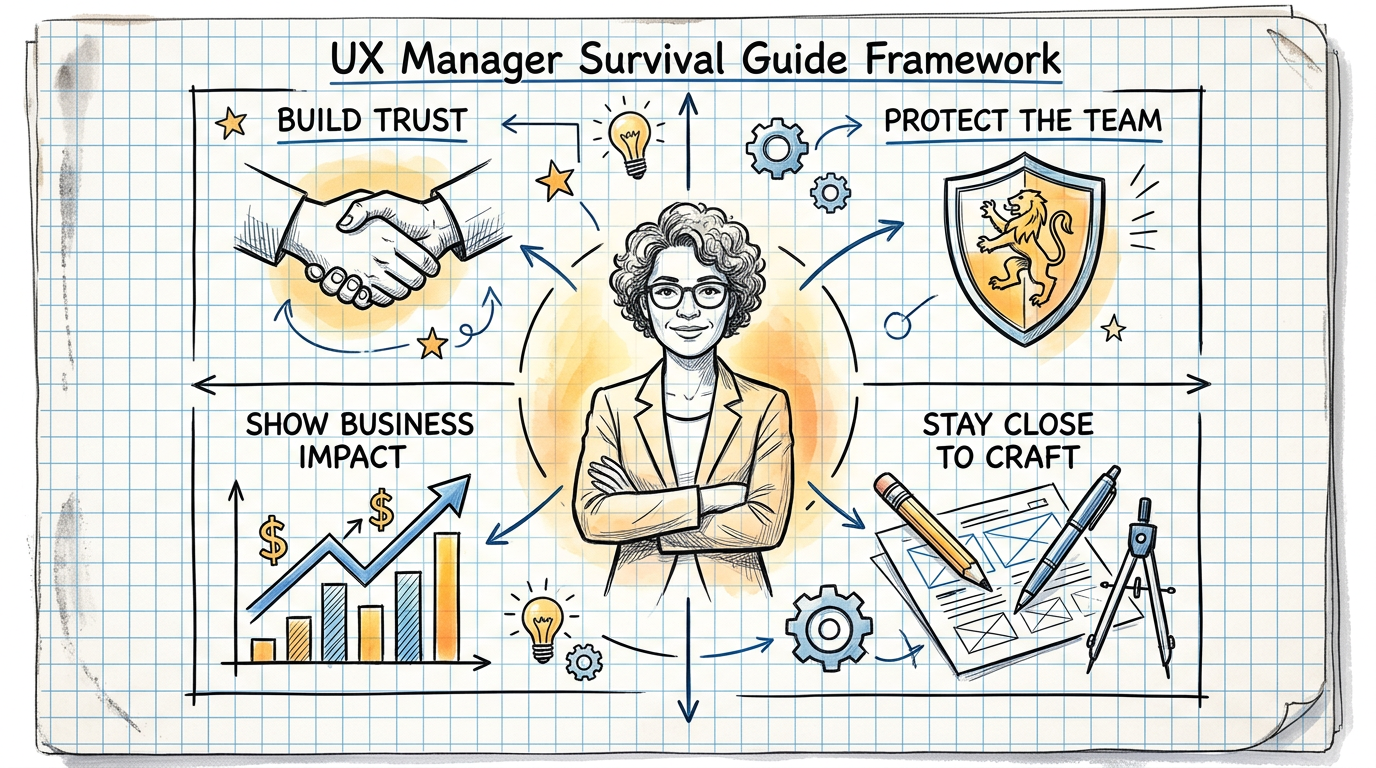
For those who are UX Managers or about to become one, here's what I wish someone had told me:
1. Build Trust Before Changing Anything
Don't rush to change processes in your first month. Take time to understand — what does the team need? What are the business pain points? Why do current processes exist?
Trust must be built before authority follows.
2. Shield Your Team from Noise
The most important job of a UX Manager is being a barrier between the team and external chaos.
- Stakeholders change their mind every week? You handle it, don't pass it to the team.
- Features get added mid-sprint? You push back, not let the team crunch.
- Executives give subjective feedback? You translate it into actionable items before passing it on.
3. Demonstrate Business Impact
Don't wait for people to ask "what does UX actually do?" — tell them first.
- Create monthly reports translating UX work into business metrics
- Document before/after of every design change with numbers
- Build a library of case studies as evidence
4. Don't Abandon the Craft
Even as a manager, don't stop doing design entirely.
You don't need to design every feature, but choose 1–2 of the most complex projects to do yourself, so you can:
- Keep your skills sharp
- Understand the pain points your team actually faces
- Maintain credibility as a design leader
5. Invest in People
The most worthwhile long-term investment is making the team stronger.
- Build a design system that reduces friction
- Have quality 1-on-1s — actually listen, don't just check status
- Let Juniors try leading projects (with appropriate guardrails)
- Share context about business decisions — a team that understands "why" makes better decisions
6. Take Care of Yourself
UX Manager burnout rates are extremely high — because you absorb pressure from every direction.
- Set clear boundaries — you don't need to reply to Slack after 8 PM
- Find a mentor who's also a manager — someone who understands what you're going through
- Accept that some days "good enough" is enough — you don't have to be perfect every day
Final Thought: Not Rose Petals, But Not a Dead End Either
Being a UX Manager is hard — harder than anyone tells you, harder than the job description says.
You'll be exhausted. You'll feel discouraged. You'll feel like you can't keep up. You'll question why you didn't just stay as an IC.
But when you see a Junior who once struggled now confidently leading a project on their own. When you see a product your team built helping users do something that used to be hard with ease. When you see that the team you built is strong enough to function even when you're not there.
You'll know it was worth it.
The path to UX Manager isn't paved with rose petals.
But the flowers you plant — they'll bloom on their own, if you tend to them well enough.